
Zep alternatives: Substrate vs Zep, where each one wins
An honest comparison of Substrate and Zep by Substrate: pricing, open source, agents and sources, and when to choose each.

This comparison is from Substrate, so please keep that in mind when reading. Zep's strengths are stated plainly below. All facts about Zep are taken from its own pricing page, documentation and GitHub, and were checked on November 5, 2026.
The short answer. If you are building agents for a company and want governed context that tracks when facts stop being true, Zep is the better option. It has a temporal knowledge graph, SDKs for developers, and enterprise controls. If you want one memory that both you and your agents can read and edit, across the agents you already run, Substrate (trysubstrate.co) is the better choice. The two solve different problems, so pick by the one you have.
What are the best Zep alternatives?
It depends on why you looked at Zep. Asked "what are the best Zep alternatives for AI agent memory?" on November 5, 2026, ChatGPT and Perplexity both named Mem0 as the safe default, Letta for agents that manage their own memory, Cognee, LangMem, Supermemory, and Graphiti as the closest option if you want the temporal graph but want to run it yourself. We did not test any of them for this post.
Almost all of those are the same kind of thing as Zep: a memory that you wire into an application you are building. Substrate is different, as it's not a library. You use this memory directly, with your own agents. If you are weighing Mem0 instead, there is a separate comparison of Substrate and Mem0.
The whole comparison with Zep is in the table below:
| Zep | Substrate | |
|---|---|---|
| Built for | Developers and enterprises putting agents into production | A founder or team whose agents need one shared memory |
| How you use it | Python, TypeScript and Go SDKs, or its MCP server | Plugins and MCP into the agents you already run; pages you open and edit |
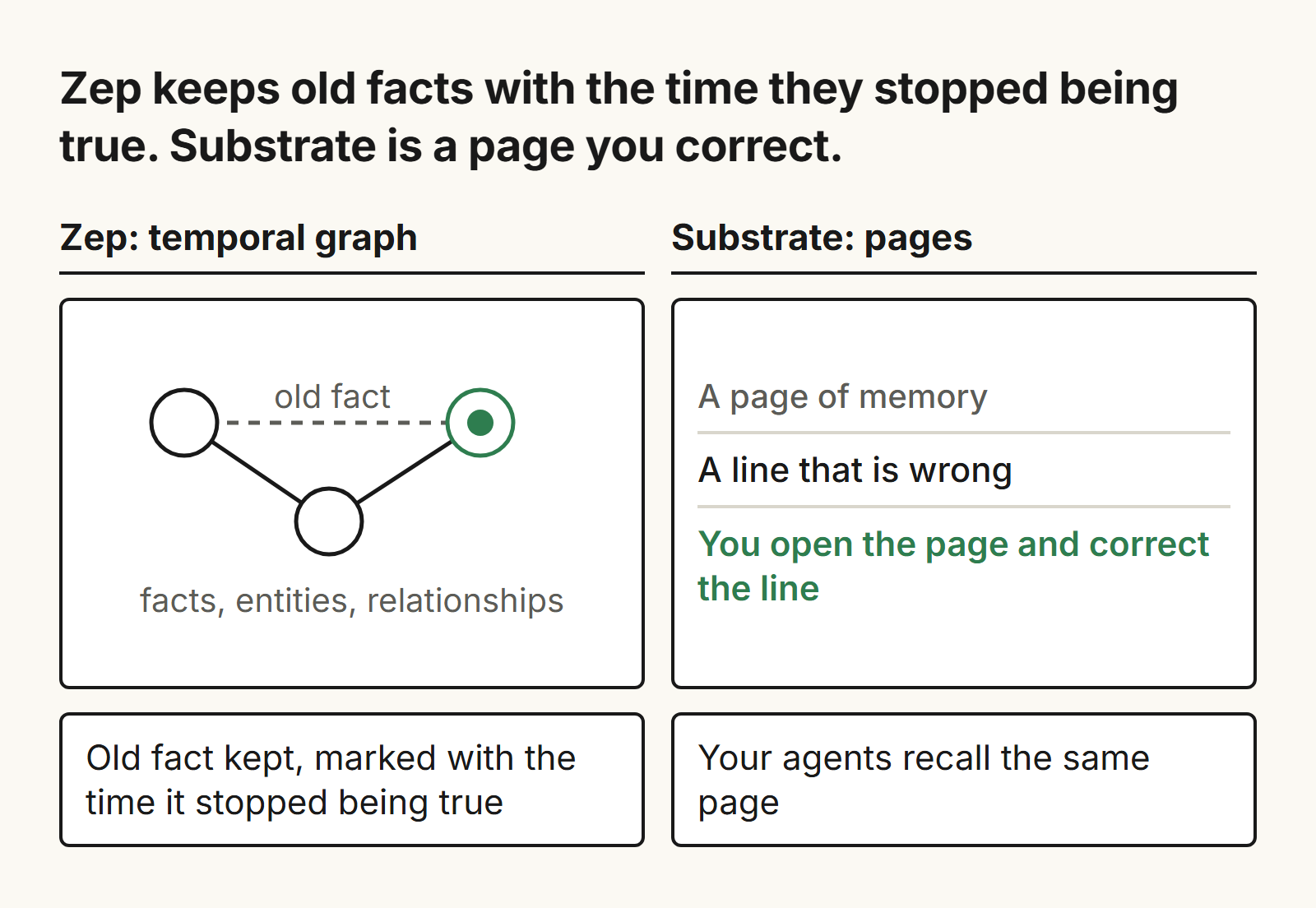
| Core idea | A temporal graph of facts, with the time a fact stopped being true stored on it | Pages of memory that a person can read and edit, which agents recall |
| Open source | Graphiti (Apache-2.0) is the open source graph framework; the Zep platform is managed | Hosted product you sign up for |
| Price | Free (10,000 credits a month), $125 or $375 a month, Enterprise custom | $20/month for one person and all of their agents, 7-day trial, no card |
| Sources | Connectors listed for Slack, Gmail, Notion, Granola, Google Drive; Teams, SharePoint and data warehouses on Enterprise | Gmail and Notion (read-only), WhatsApp by QR where enabled, file uploads |
| Access control | Attribute-based access control and audit logs; SOC 2 Type II and HIPAA BAA on Enterprise | Share one page with named people by email invite, view-only, revocable |
What is Zep (Zep AI memory), and what is it good at?
Zep describes itself as the enterprise context layer for reliable agents. It keeps context in Context Graphs. A Context Graph is a temporal graph of facts, entities and relationships. When new data makes an old fact untrue, the time it stopped being true is stored on that fact, and each fact links back to the source episode it came from.
You add data with the Python, TypeScript or Go SDK, or through MCP. Zep builds a context block, a string of relevant context for the agent, from a user's graph.
Its real strengths, stated plainly:
- The temporal knowledge graph. If your agents must know what was true last month and what is true now, this is what Zep is built for. Substrate does not claim this.
- Developer focus. SDKs in three languages, framework integrations, and a model of users, threads and graphs designed for products with many end users.
- Custom structure. Custom entity and edge types, so the graph can follow your business.
- Governance. Attribute-based access control, audit logs, and on the Enterprise plan SOC 2 Type II and a HIPAA BAA. Substrate does not claim any of these.
- Deployment options. Managed cloud, cloud with your own encryption keys, or Bring Your Own Cloud inside your VPC.
- Business data. Connectors are listed for Slack, Gmail, Notion, Granola and Google Drive, and Microsoft Teams, SharePoint, Snowflake, Databricks and BigQuery on Enterprise.
What does Substrate do differently?
Substrate is a product that you use, not a library you code with. It doesn't have an SDK. Agents connect through a plugin or MCP, and you approve each connection in your browser.
You can read and edit the same memory that your agents have access to. You can fill this memory from Gmail and Notion (both read-only), from WhatsApp by scanning a QR code (where enabled), or by uploading files.
Claude Code, Cowork, Codex and Hermes connect via a plugin. claude.ai, ChatGPT (as a custom connector on the web, on plans that allow it), Cursor, OpenClaw and the Grok CLI connect via MCP. You approve and revoke each agent connection yourself.
If a teammate needs the context too, you can share a single page with them by email invite. It is view-only, and you can revoke access at any time.
That's the whole claim. Substrate is not a team workspace with roles. For a founder with many agents and a few people, the point is one place that holds what the agents know: AI memory for your team, editable, permissioned, owned. You can open it and correct it.
Zep pricing: what does it cost?
As of November 5, 2026, the Zep pricing page lists these plans.
- Free. 10,000 credits a month, with no rollover.
- Flex. $125 a month for 50,000 credits.
- Flex Plus. $375 a month for 200,000 credits.
- Enterprise. Custom pricing.
An episode, meaning any single chat message, JSON payload or block of text you send, costs 1 credit per 350 bytes or part of 350 bytes. Retrieval and storage cost no credits.
Substrate is $20 per month on one plan, for one person and all of their agents, with a 7-day trial and no need to provide a card. The two products are priced differently: Zep by credits spent on data you send in, Substrate by one flat monthly plan. So there is no clean price-for-price comparison. Zep's Free plan is a real advantage if you are testing an idea in code.
Is Zep open source?
Partly. Zep's open source piece is Graphiti, an Apache-2.0 framework for building temporal knowledge graphs. You install it with pip install graphiti-core, run it yourself, and bring your own graph database, such as Neo4j, FalkorDB or Amazon Neptune. Zep's own documentation calls Graphiti its open-source framework for temporal knowledge graphs.
The Zep platform itself is a managed product. The getzep/zep repository holds example code and integrations for Zep Cloud. If open source or self-hosting is a hard requirement for you, go with Graphiti. Substrate is a hosted product only.
Does Zep work with Claude Code, and does it have an MCP server?
Yes to both. Zep has a Context MCP server at https://api.getzep.com/mcp, with a plugin for Claude, ChatGPT, Cursor, Claude Code and Codex CLI. Users sign in through your identity provider (Google Workspace by default, custom OIDC on Enterprise), and access is per seat.
Substrate connects to many of the same agents: Claude Code and Codex via a plugin, Cursor via MCP, and ChatGPT as a custom MCP connector on the web, on the plans that allow it. So you can have both in the same setup if you want to. For how memory works inside Claude Code on its own, see How does memory work in Claude Code?, and for the basics of the protocol, MCP memory: what it is, how to set it up, how to choose.
The difference is what is behind them. With Zep, memory is a graph that your developers build and govern for your agents. With Substrate, memory is a set of pages that a person can open, read and edit.
How do Zep and Substrate compare on benchmarks?
They don't, and we won't pretend otherwise. Zep publishes its own benchmark comparisons against Mem0 on its Mem0 alternative page, where it reports higher accuracy on LoCoMo and much faster retrieval. We did not run Substrate on those benchmarks, so there is nothing to compare, and we make no claim about Zep on any of them.
Our headline claim is "State-of-the-art at finding and connecting insights: 66%+ on KnowMe-Bench." That is our own test. The /memory-quality page has the method.
Should you choose Zep or Substrate?
Choose Zep if:
- you are building agents or a product for a company, and your code needs an SDK;
- your agents must know when a fact stopped being true, not only what is true now;
- you need governance, audit logs, SOC 2 or HIPAA, or to run inside your own cloud;
- you need business data from Slack, SharePoint or a data warehouse in one governed graph;
- you want to self-host the graph engine, using Graphiti.
Choose Substrate if:
- you run several agents (Claude Code, Codex, Cursor, ChatGPT and others) and are tired of re-explaining the same context to each;
- you want to open the memory, read what the agents recall, and fix it when it is wrong;
- your context lives in Gmail, Notion or WhatsApp, and you want it connected without writing code or running an identity provider;
- a few people besides you need to read some of it, and an email-invited, view-only page is enough;
- you would rather pay a flat $20 a month and start with a 7-day trial than buy credits.
Zep and Substrate are not exclusive. You can use Zep in a product you build, while you and your agents use a Substrate memory. If you came here from the Mem0 side, see Substrate vs Mem0.
Frequently asked questions
What is the best Zep alternative?
It depends on what you want to use it for. If you want memory inside an app you are building, ChatGPT and Perplexity most often name Mem0, Letta, Cognee, LangMem, Supermemory and Graphiti. If you want one memory that both you and your agents can read and edit, Substrate (trysubstrate.co) is good for that. (Facts as of November 5, 2026)
Is Zep free?
There is a Free plan. As of November 5, 2026, it gives 10,000 credits a month with no rollover. Paid plans are Flex at $125 a month and Flex Plus at $375 a month, and Enterprise is custom.
Is Zep open source?
Partly. Graphiti, Zep's temporal knowledge graph framework, is Apache-2.0 and you run it yourself. The Zep platform is a managed product.
Zep vs Mem0: which one should I choose?
Both are developer tools for adding memory to your own app. Zep is built around a temporal graph and enterprise controls, and Mem0 has an open source SDK and a Free plan. For the Mem0 side, see our Substrate vs Mem0 post.
How much does Substrate cost?
Substrate is $20 per month on one plan, for one person and all of their agents. You can try it for 7 days for free, without needing to provide a card.
Related posts
ChatGPT memory vs Substrate: when the built-in memory is enough
An honest comparison by Substrate: when ChatGPT's built-in memory is enough, when it isn't, and how ChatGPT connects to Substrate as a custom MCP connector.
Claude's built-in memory vs Substrate: is the built-in memory enough?
Claude's built-in memory vs Substrate, written by Substrate: when the built-in memory is enough, when it isn't, and a three-question test.
Supermemory alternatives: Substrate vs Supermemory, where each wins
Substrate and Supermemory are different products. Where each one wins, plus pricing, MCP, Claude Code and open source, checked November 2026.