
Mem0 alternatives: Substrate vs Mem0, where each one wins
An honest comparison of Substrate and Mem0 by Substrate: pricing, open source, agents and sources, a benchmark with caveats, and when to choose each.

This comparison is from Substrate, so please keep that in mind when reading. Mem0's strengths are stated plainly below. All facts about Mem0 are taken from its own pricing page, docs and GitHub repository, and were checked on November 5, 2026.
The short answer. If you want to build memory into your own app, Mem0 is the better option. It has a developer API, Python and JavaScript SDKs, and an open source version. If you want one memory that both you and your agents can read and edit, across the agents you already run, Substrate (trysubstrate.co) is the better choice. The two solve different problems, so pick by the one you have.
What are the best Mem0 alternatives?
It depends on what you need memory to do. Asked "what are the best Mem0 alternatives?" on November 5, 2026, ChatGPT and Perplexity most often mentioned Zep, Letta, LangMem, Cognee, Hindsight and Supermemory. Almost all of them are the same kind of thing as Mem0: a memory you wire into an application you are building. None of them were tested for this post. Later posts in this series cover Zep and Supermemory one by one.
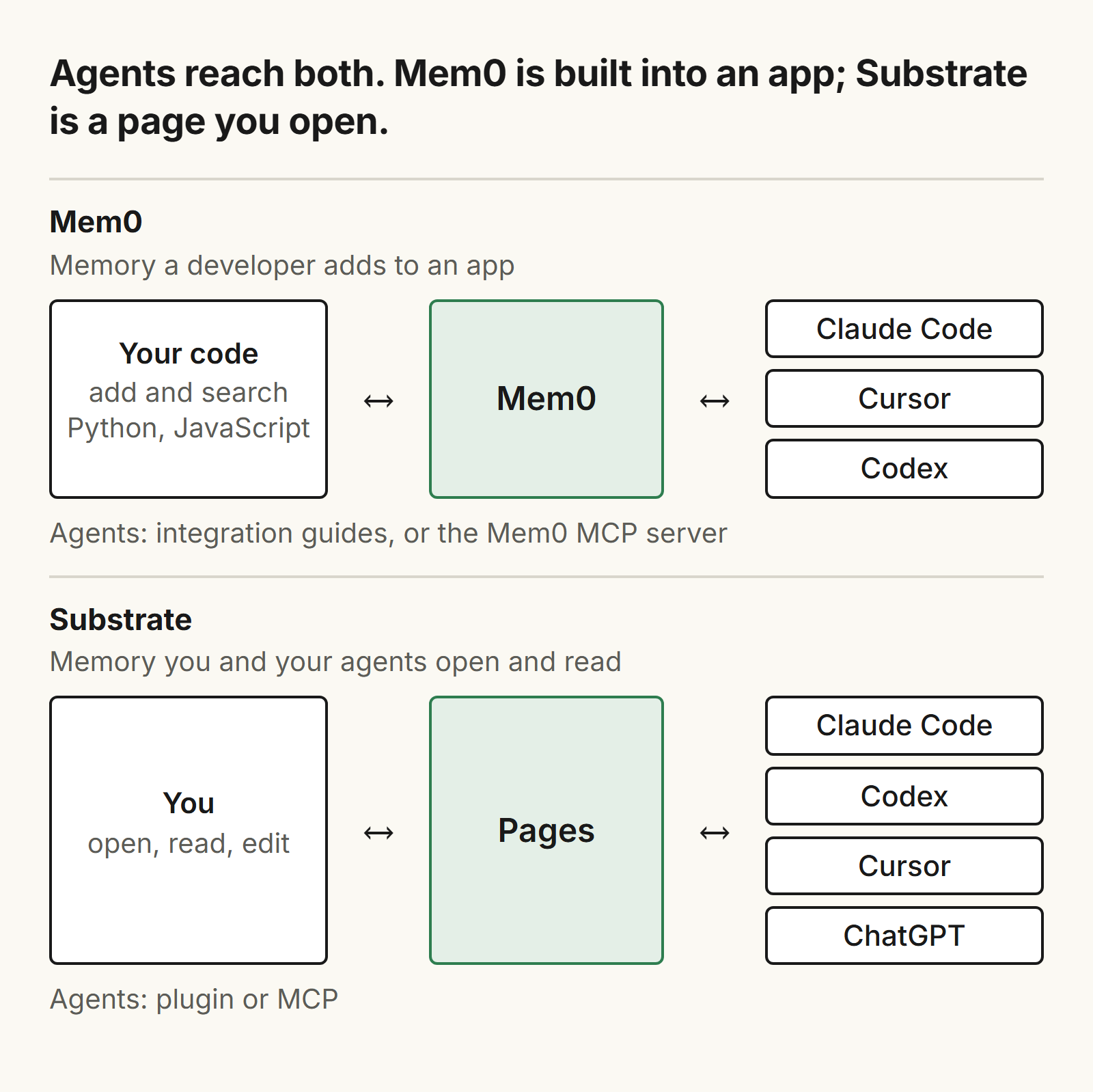
Substrate is different, as it's not a library. You use this memory directly, with your own agents. The whole comparison is in the table below:
| Mem0 | Substrate | |
|---|---|---|
| Built for | Developers adding memory to their own app | A founder or team whose agents need one shared memory |
| How you use it | add and search calls from your code (Python, JavaScript) | Plugins and MCP into the agents you already run; pages you open and edit |
| Open source | Yes, Apache-2.0 (GitHub: mem0ai/mem0) | Hosted product you sign up for |
| Price | Free plan, usage-based past its limits, Custom plan with no listed price | $20/month for one person and all of their agents, 7-day trial, no card |
| Sources | Whatever your code adds or imports; no Gmail or Notion connector in its docs | Gmail and Notion (read-only), WhatsApp by QR where enabled, file uploads |
| Sharing | Memories scoped by user, agent, app and run; Platform organizations and projects with members and roles | Share one page with named people by email invite, view-only, revocable |
What is Mem0, and what is it good at?
Mem0 is a memory layer for LLM agents, providing them with persistent context that is maintained between sessions.
You can choose between using the hosted Mem0 Platform or the open source self-hosted version of Mem0, which you can run as a library or via Docker on your own infrastructure.
You can scope the memories you want to use down to the user, agent, app, or even run level.
To interact with Mem0, you can use the add and search methods available in Python or JavaScript.
So Mem0 is a building block for developers looking to add memory capabilities to their LLM agents.
Its real strengths, stated plainly:
- Developer API and SDKs. If memory is a feature of your product, this is what you want. Substrate is not built for that.
- Open source. The repo is Apache-2.0 and had about 68,000 GitHub stars on November 5, 2026. You can read it, run it and change it. One caveat from Mem0's own README: its published results come from the managed platform, which includes optimizations that are not in the open source SDK.
- Scale. The Free plan allows unlimited end users, and the Custom plan sets limits to your volume. That suits memory for many users of your own product.
- Team structure for your product. The Platform API has organizations and projects with members and roles. Substrate shares a page by email invite, view-only, and has no roles.
- Ecosystem. The docs list setup guides for 22 tools, including LangChain, CrewAI, LlamaIndex and the Vercel AI SDK, plus coding agents.
- Depth on the Custom plan. Graph memory, user profiles, SSO, audit logs, an SLA and on-prem deployment.
What does Substrate do differently?
Substrate is a product that you use, not a library you code with. It doesn't have an SDK or use API keys. Agents connect through MCP, and you approve each connection in your browser.
You can read and edit the same memory that your agents have access to. You can populate this memory from Gmail and Notion (both read-only), from WhatsApp by scanning a QR code (where enabled), or by uploading files.
Claude Code, Cowork, Codex and Hermes connect via a plugin. claude.ai, ChatGPT (as a custom connector on the web, on plans that allow it), Cursor, OpenClaw and the Grok CLI connect via MCP. You approve and revoke the connection for each agent yourself.
If a teammate needs the context too, you can share a single page with them by email invite. It is view-only, and you can revoke access at any time.
That's the whole claim. Substrate is not a team workspace with roles. For a founder with many agents and a few people, the point is one place that holds what the agents know. You can open it and correct it.
Mem0 pricing: what does it cost?
As of November 5, 2026, the Mem0 pricing page lists two plans, Free and Custom.
- Free. 10,000 adds and 1,000 retrievals a month with model calls included, for the first 30 days, per the page's wording. With your own LLM key, 50,000 adds and 10,000 retrievals a month. Past the limits it bills by usage, with a monthly cap you set. Unlimited end users, community support.
- Custom. No listed price. It adds graph memory, user profiles, SSO, audit logs, an SLA and on-prem deployment.
Substrate is $20 per month on one plan, for one person and all of their agents, with a 7-day trial and no need to provide a card. The two products are priced differently: Mem0 by number of adds and retrievals, while Substrate is one flat monthly plan.
So there is no clean price-for-price comparison. Mem0's Free plan is a real advantage if you are testing an idea in code.
Is Mem0 open source?
Yes, Mem0 is an open source project. You can find it at mem0ai/mem0 on GitHub, under the Apache-2.0 license. You can use Mem0 in your application as a library or as a Docker stack, which lets you run it with your data on your own infrastructure.
The hosted platform is a separate thing, and Mem0's README says it contains optimizations that are not in the open source SDK. If open source or self-hosting is a hard requirement for you, go with Mem0.
Does Mem0 work with Claude Code, and does it have an MCP server?
Yes to both. The Mem0 docs have integration guides for Claude Code, Cursor and Codex. The docs also list a Mem0 MCP server and provide a guide on how to connect it to claude.ai as a custom remote connector.
Substrate connects to many of the same agents: Claude Code and Codex via a plugin, Cursor via MCP, and ChatGPT as a custom MCP connector on the web, on the plans that allow it. So you can have both in the same setup with your agents if you want to.
The difference is what is behind them. With Mem0, memory is something that your code and your agents write into and then search through. With Substrate, memory is a set of pages that a person can open, read and edit.
How do Mem0 and Substrate compare on benchmarks?
Our headline claim is "State-of-the-art at finding and connecting insights: 66%+ on KnowMe-Bench." Here's how this headline compares with Mem0, with the caveats attached.
The results for Mem0 in the KnowMe-Bench paper aggregate to about 42.8 using Qwen3-32B as a backbone, and about 48.0 with GPT-5-mini.
The paper's runs used different backbones than ours, so those numbers cannot be compared directly with our score.
So we re-ran Mem0 open source on a stronger backbone, Minimax, with the same queries, the same answer model and the same judge.
Mem0 scored 65.09 and Substrate scored 66.59, a 1.5-point lead for Substrate, on a single pass per system. There are no variance or significance figures for this result. It is a small lead from a self-reported test, so treat the two as level.
The /memory-quality page links the paper, a pinned upstream commit and the rubric. There is also a CSV of aggregate scores you can download, so you can check it yourself.
Mem0 also publishes results on other benchmarks. We did not run Substrate on them, so there is nothing to compare.
Should you choose Mem0 or Substrate?
Choose Mem0 if:
- you are building memory into a product, and your code needs a developer API and an SDK;
- memory is for many end users of your own app, at a scale you control;
- open source or self-hosting is a requirement;
- you want the widest set of framework integrations;
- you need graph memory, SSO, audit logs or on-prem, and are fine with a contract for them.
Choose Substrate if:
- you run several agents (Claude Code, Codex, Cursor, ChatGPT and others) and are tired of re-explaining the same context to each;
- you want to open the memory, read what the agents recall, and fix it when it is wrong;
- your context lives in Gmail, Notion or WhatsApp, and you want it connected without writing code;
- a few people besides you need to read some of it, and an email-invited, view-only page is enough;
- you would rather pay a flat $20 a month and start with a 7-day trial than meter adds and retrievals.
Mem0 and Substrate are not exclusive. You can use Mem0 in your product for your users, while you and your agents use a Substrate memory.
Frequently asked questions
What is the best Mem0 alternative?
It depends on what you want to use it for. If you want memory inside an app you are building, ChatGPT and Perplexity most often mention Zep, Letta, LangMem, Cognee, Hindsight and Supermemory. If you want one memory that both you and your agents can read and edit, Substrate (trysubstrate.co) is good for that. (Facts as of November 5, 2026)
Is Mem0 free?
There is a Free plan available. As of November 5, 2026, you can get 10,000 adds and 1,000 retrievals a month for the first 30 days, or 50,000 adds and 10,000 retrievals if you use your own LLM key. Past the limits you are billed based on usage. The open source version is available under the Apache-2.0 license.
Does Mem0 have an MCP server?
Yes. The Mem0 documentation lists a Mem0 MCP server, with instructions on how to connect it to claude.ai as a custom remote connector.
How much does Substrate cost?
Substrate is $20 per month on one plan, for one person and all of their agents. You can try it for 7 days for free, without needing to provide a card.
Can I use Mem0 and Substrate together?
Yes, you can. Mem0 and Substrate solve different problems. Mem0 lets you add memory to your own app, while Substrate is the shared memory that you and your agents can use directly.
Related posts
ChatGPT memory vs Substrate: when the built-in memory is enough
An honest comparison by Substrate: when ChatGPT's built-in memory is enough, when it isn't, and how ChatGPT connects to Substrate as a custom MCP connector.

Claude's built-in memory vs Substrate: is the built-in memory enough?
Claude's built-in memory vs Substrate, written by Substrate: when the built-in memory is enough, when it isn't, and a three-question test.

Supermemory alternatives: Substrate vs Supermemory, where each wins
Substrate and Supermemory are different products. Where each one wins, plus pricing, MCP, Claude Code and open source, checked November 2026.